Automotive Ac Leak Detector Explained: A UK Buyer's Guide
`. I'll be sure to include all of the required components, such as a "Key Takeaways" box and a CTA section. I am remembering the data point or statistic as well.
**Prioritizing UK Nuances**
I'm incorporating UK-specific details, such as F-Gas regulations, the MOT, and the British climate's impact on AC systems. I'm focusing on these elements to ensure the blog post resonates with a UK audience and their specific needs and considerations. I'm also preparing to mark image placement with `` markers, and will include a "Frequently Asked Questions" section. I will keep the focus squarely on automotive AC leak detectors, and nothing else.
**Outlining the Sections**
I'm now structuring the blog post sections. Section 2 will discuss why UK mechanics require dedicated leak detection tools, referencing F-Gas regulations and citing relevant emissions statistics. Sections 3 will describe various detector types, with a focus on a premium product. Section 4 will be a buyer's guide and detail key features. Finally, section 5 will outline the step-by-step usage guide.
**Finalizing the Structure**
I've finalized section details, including "The RefriLeak Advantage," the CTA, and an FAQ section. I've integrated the brand's 3g/y heated diode tech into the piece, and crafted a clear call to action. I also outlined 3-4 Q&As. I will now concentrate on drafting content, and I am aware of the challenge of hitting the word count for a detailed niche topic. I'll maintain an authoritative tone suitable for UK mechanics.
**Drafting the Introduction**
I'm starting the content with the scenario of an AC failure shortly after a regas, setting the stage for the importance of leak detection. I've also integrated the "Key Takeaways" bulleted list. The F-Gas regulation stat is in place, as well as the price of R1234yf in the UK. I'm focusing on the integration of internal links, mentioning the RefriLeak's 3g/y heated diode detector. I will proceed with content development.
**Expanding the Content**
I'm now detailing the heated diode tech, contrasting its effectiveness in an automotive environment against other technologies. I'm focusing on the practical inspection process, detailing common leak points and the detector maintenance requirements. I'm expanding on the UK automotive context by discussing the MOT's link to demister functionality, alongside the impact of the UK's weather on AC system usage.
**Refining the Details**
I'm now iterating on the content and confirming the focus on the "automotive ac leak detector" keyword. I've eliminated unnecessary transition words and confirmed British English. I'm keeping the data point for F-Gas fines and R1234yf costs, and I've added a few more internal links, and am keeping the image markers. The FAQ is set to be four questions. I am ensuring that the content differentiates clearly between general HVAC detectors and those specifically for automotive AC systems, noting the challenges of confined spaces and engine fans.
**Calculating Word Count**
I've projected the word count, aiming for approximately 1800 words, by outlining the article's sections and estimating the word count per section. I've broken down the topic into sub-headings, including "The Shift in UK Refrigerants" and "Core Technologies," allocating words per section. I am making sure to exclude any prohibited words, and will check internal links are formatted correctly.
Key Takeaways
- An automotive AC leak detector is essential for complying with strict UK F-Gas regulations and avoiding hefty fines.
- Modern vehicles use R1234yf refrigerant, which is significantly more expensive than older gases, making pinpoint leak detection a financial necessity for garages.
- Heated diode technology offers the best balance of sensitivity (down to 3g/year) and reliability in dirty engine bays.
- Investing in a professional-grade tool eliminates the guesswork of UV dyes and speeds up diagnostic times for busy UK mechanics.
A customer brings their car into your workshop. You regassed their air conditioning just two weeks ago, and now it is blowing warm air again. The refrigerant has vanished, and the clock is ticking to find out exactly where it went. Guesswork in this scenario costs time, money, and reputation. You need a dedicated automotive AC leak detector to identify the fault instantly.
Vehicle air conditioning systems operate in harsh environments. They endure constant vibration, extreme temperature fluctuations, and impact from road debris. Micro-leaks are inevitable. Finding them requires tools specifically calibrated for the confined, messy space of an engine bay.
This guide breaks down everything UK engineers and garage owners need to know about selecting and using the right diagnostic equipment for vehicle climate control systems.
The UK Landscape: Why Leak Detection Matters More Than Ever
The days of topping up a leaking system and sending the customer on their way are long gone. The UK automotive industry operates under stringent environmental and economic pressures that make accurate diagnostics non-negotiable.
F-Gas Regulations and Legal Compliance
In the UK, intentionally venting fluorinated greenhouse gases into the atmosphere is a criminal offence. The Environment Agency enforces the F-Gas Regulations, and the penalties for non-compliance are severe. According to UK government guidelines, civil penalties for breaching F-Gas regulations can reach up to £200,000.
Mechanics must recover existing gas and repair leaks before recharging a system. An accurate automotive AC leak detector ensures you are legally compliant and not inadvertently contributing to environmental damage by charging a compromised circuit.
The High Cost of R1234yf
Since 2017, all new cars sold in the UK must use R1234yf refrigerant due to its low global warming potential. This environmental benefit comes with a steep financial cost. R1234yf is vastly more expensive than the legacy R134a gas.
Wasting a canister of R1234yf on a system with an undetected leak is an expensive mistake that directly eats into your garage's profit margins. Using a high-sensitivity detector protects your bottom line by ensuring the system is completely sealed before you commit expensive refrigerant to it.
Decoding the Technology Behind the Tools
Not all diagnostic tools are created equal. An automotive AC leak detector must filter out background interference like petrol fumes, engine oil, and screenwash to pinpoint a refrigerant leak accurately. Understanding the underlying technology helps you choose the right tool for your workshop.
Heated Diode Detectors
This is the gold standard for professional automotive applications. A heated diode sensor works by heating the surrounding air. When a halogenated refrigerant passes over the heated element, a chemical reaction occurs, altering the electrical current. The device registers this change and triggers an alarm.
Heated diode sensors are exceptionally sensitive. Premium models can detect leaks as small as 3g per year. They also excel at resisting false alarms caused by moisture or engine bay grime, making them ideal for UK mechanics working in less-than-ideal conditions.
Infrared (IR) Detectors
Infrared detectors pull air through an optical chamber. If refrigerant gas is present, it absorbs a specific wavelength of infrared light. The sensor detects this drop in light intensity and alerts the user.
IR sensors boast a long lifespan and do not degrade when exposed to high concentrations of gas. They are highly accurate but tend to sit at the top end of the price spectrum. For those looking at versatile options, exploring a dedicated HVAC refrigerant sniffer can provide additional insights into IR capabilities.
Corona Discharge Detectors
These are the traditional, budget-friendly options. They create a high-voltage electrical field (a corona) at the sensor tip. When refrigerant enters this field, it interrupts the current.
While affordable, corona discharge tools are prone to false positives in automotive settings. A stray breeze, heavy moisture, or even steering fluid fumes can trigger them. They also degrade quickly if exposed to large doses of refrigerant.
What to Look for in an Automotive AC Leak Detector
When equipping your garage, you need a tool that balances sensitivity, durability, and ease of use. Keep these critical features in mind during your selection process.
Sensitivity Ratings
Sensitivity is measured in grams per year (g/y). A lower number means the device can detect smaller leaks. For automotive use, you should insist on a detector capable of spotting a 3g/y leak. Anything less sensitive will struggle to find the micro-leaks that cause a system to lose pressure slowly over a summer season.
Gas Compatibility
Your chosen tool must be compatible with the gases prevalent in the UK market. It must detect R134a (found in older vehicles) and R1234yf (standard in modern cars). If you service hybrid or electric vehicles, ensure the device is also safe to use around their specific thermal management systems.
Sensor Lifespan and Replacement
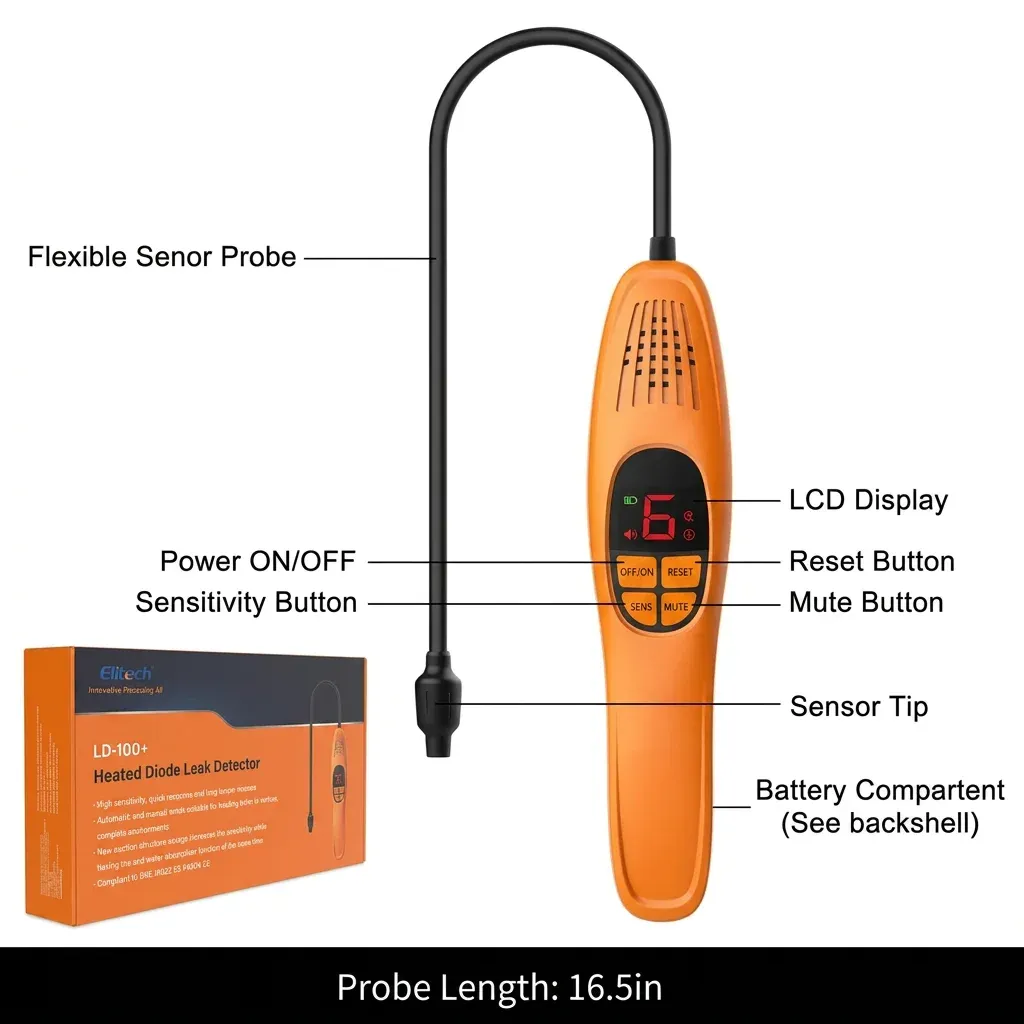
Sensors are consumable items. Heated diode and corona discharge sensors degrade over time. Check the average lifespan of the sensor and the cost of replacements. A tool with cheap, readily available replacement sensors will cost you less in the long run. If you are comparing specific models, you might want to look into how the Elitech LD-100+ handles sensor longevity.
Ergonomics and Probe Design
Engine bays are cramped. You need a flexible probe that can snake around engine blocks, alternators, and cooling fans to reach the AC compressor and condenser lines. A probe length of at least 35cm to 40cm is ideal for automotive applications.
How to Pinpoint Leaks Like a Professional
Owning a premium automotive AC leak detector is only half the battle. Using it systematically guarantees you find the fault quickly. Follow this workflow for the best results in your workshop.
1. Prepare the Vehicle
Ensure the engine is off and the vehicle is parked in a well-ventilated, draught-free area. Wind can blow the leaking refrigerant away from your sensor, making detection nearly impossible. If you are working outside on a typical windy British day, try to shield the front of the car.
2. Establish a Baseline
Turn on your detector away from the vehicle to allow it to calibrate to the clean ambient air. This prevents false positives and ensures the sensor is operating at maximum sensitivity.
3. Check the Condenser
Start at the front of the vehicle. The AC condenser sits right behind the grille, making it highly vulnerable to stone chips on the M1 or rural country lanes. Slowly sweep the probe across the fins, paying close attention to the bottom corners where debris and moisture gather to cause corrosion.
4. Follow the Lines
Trace the high and low-pressure lines back through the engine bay. Move the probe slowly—about 1 to 2 inches per second. Rushing is the most common reason mechanics miss small leaks. Check every joint, crimp, and O-ring. Keep the probe tip below the lines, as refrigerant gases are heavier than air and will sink.
5. Inspect the Compressor and Evaporator
Check the compressor shaft seal, a notorious weak point as vehicles age. Finally, inspect the evaporator. Since the evaporator is buried inside the dashboard, insert the probe into the interior air vents or the air conditioning condensation drain tube beneath the car. A positive reading here confirms a dash-out repair is necessary.
The RefriLeak Advantage
At RefriLeak, we understand the demands placed on UK automotive technicians. You need equipment that works first time, every time. We proudly position our flagship tool as the professional air conditioning leak detector for UK engineers.
Our premium detector utilizes advanced heated diode technology to pinpoint elusive faults instantly. With a certified sensitivity of 3g/y, it easily detects the smallest R134a and R1234yf leaks that other budget tools miss. The rugged design withstands daily garage use, while the flexible probe ensures no pipe or fitting is out of reach.
Stop wasting time with messy UV dyes and unreliable bubble solutions. Upgrade your diagnostic capabilities and protect your profit margins by investing in a tool designed specifically for the modern automotive professional. For a broader look at how these tools fit into your overall toolkit, review our comprehensive guide to freon leak detectors.
Ready to Upgrade Your Diagnostic Arsenal?
Don't let elusive leaks cost your garage time and money. Pinpoint faults instantly with our premium 3g/y heated diode refrigerant leak detector.
Shop the RefriLeak Detector Now
Frequently Asked Questions
Can an automotive AC leak detector find leaks in hybrid cars?
Yes. Hybrid and electric vehicles often use the same refrigerants (like R1234yf) for their cabin cooling and battery thermal management systems. A high-quality detector will locate leaks in these complex systems just as effectively as in a traditional internal combustion engine vehicle.
Why is my leak detector going off when there is no refrigerant?
False positives are usually caused by background contamination. Spilled antifreeze, brake cleaner, strong petrol fumes, or even heavy condensation can trigger lower-quality corona discharge sensors. Ensure you are using a heated diode detector and wipe away heavy grease from the pipes before scanning.
How often should I replace the sensor in my detector?
This depends heavily on usage and the type of technology. For a busy UK garage using a heated diode detector daily, the sensor tip typically lasts between 100 to 300 hours of active scanning. If you notice a drop in sensitivity or erratic behavior during calibration, it is time to install a replacement tip.
Are UV dyes better than electronic leak detectors?
UV dyes and electronic detectors serve different purposes. Dyes are excellent for finding large, historical leaks where the oil has sprayed across the engine bay. An electronic automotive AC leak detector is vastly superior for finding active micro-leaks, especially in hidden areas like the evaporator core where a UV light cannot reach.
Key Takeaways
- An automotive AC leak detector is essential for complying with strict UK F-Gas regulations and avoiding hefty fines.
- Modern vehicles use R1234yf refrigerant, which is significantly more expensive than older gases, making pinpoint leak detection a financial necessity for garages.
- Heated diode technology offers the best balance of sensitivity (down to 3g/year) and reliability in dirty engine bays.
- Investing in a professional-grade tool eliminates the guesswork of UV dyes and speeds up diagnostic times for busy UK mechanics.
A customer brings their car into your workshop. You regassed their air conditioning just two weeks ago, and now it is blowing warm air again. The refrigerant has vanished, and the clock is ticking to find out exactly where it went. Guesswork in this scenario costs time, money, and reputation. You need a dedicated automotive AC leak detector to identify the fault instantly.
Vehicle air conditioning systems operate in harsh environments. They endure constant vibration, extreme temperature fluctuations, and impact from road debris. Micro-leaks are inevitable. Finding them requires tools specifically calibrated for the confined, messy space of an engine bay.
This guide breaks down everything UK engineers and garage owners need to know about selecting and using the right diagnostic equipment for vehicle climate control systems.
The UK Landscape: Why Leak Detection Matters More Than Ever
The days of topping up a leaking system and sending the customer on their way are long gone. The UK automotive industry operates under stringent environmental and economic pressures that make accurate diagnostics non-negotiable.
F-Gas Regulations and Legal Compliance
In the UK, intentionally venting fluorinated greenhouse gases into the atmosphere is a criminal offence. The Environment Agency enforces the F-Gas Regulations, and the penalties for non-compliance are severe. According to UK government guidelines, civil penalties for breaching F-Gas regulations can reach up to £200,000.
Mechanics must recover existing gas and repair leaks before recharging a system. An accurate automotive AC leak detector ensures you are legally compliant and not inadvertently contributing to environmental damage by charging a compromised circuit.
The High Cost of R1234yf
Since 2017, all new cars sold in the UK must use R1234yf refrigerant due to its low global warming potential. This environmental benefit comes with a steep financial cost. R1234yf is vastly more expensive than the legacy R134a gas.
Wasting a canister of R1234yf on a system with an undetected leak is an expensive mistake that directly eats into your garage's profit margins. Using a high-sensitivity detector protects your bottom line by ensuring the system is completely sealed before you commit expensive refrigerant to it.
Decoding the Technology Behind the Tools
Not all diagnostic tools are created equal. An automotive AC leak detector must filter out background interference like petrol fumes, engine oil, and screenwash to pinpoint a refrigerant leak accurately. Understanding the underlying technology helps you choose the right tool for your workshop.
Heated Diode Detectors
This is the gold standard for professional automotive applications. A heated diode sensor works by heating the surrounding air. When a halogenated refrigerant passes over the heated element, a chemical reaction occurs, altering the electrical current. The device registers this change and triggers an alarm.
Heated diode sensors are exceptionally sensitive. Premium models can detect leaks as small as 3g per year. They also excel at resisting false alarms caused by moisture or engine bay grime, making them ideal for UK mechanics working in less-than-ideal conditions.
Infrared (IR) Detectors
Infrared detectors pull air through an optical chamber. If refrigerant gas is present, it absorbs a specific wavelength of infrared light. The sensor detects this drop in light intensity and alerts the user.
IR sensors boast a long lifespan and do not degrade when exposed to high concentrations of gas. They are highly accurate but tend to sit at the top end of the price spectrum. For those looking at versatile options, exploring a dedicated HVAC refrigerant sniffer can provide additional insights into IR capabilities.
Corona Discharge Detectors
These are the traditional, budget-friendly options. They create a high-voltage electrical field (a corona) at the sensor tip. When refrigerant enters this field, it interrupts the current.
While affordable, corona discharge tools are prone to false positives in automotive settings. A stray breeze, heavy moisture, or even steering fluid fumes can trigger them. They also degrade quickly if exposed to large doses of refrigerant.
What to Look for in an Automotive AC Leak Detector
When equipping your garage, you need a tool that balances sensitivity, durability, and ease of use. Keep these critical features in mind during your selection process.
Sensitivity Ratings
Sensitivity is measured in grams per year (g/y). A lower number means the device can detect smaller leaks. For automotive use, you should insist on a detector capable of spotting a 3g/y leak. Anything less sensitive will struggle to find the micro-leaks that cause a system to lose pressure slowly over a summer season.
Gas Compatibility
Your chosen tool must be compatible with the gases prevalent in the UK market. It must detect R134a (found in older vehicles) and R1234yf (standard in modern cars). If you service hybrid or electric vehicles, ensure the device is also safe to use around their specific thermal management systems.
Sensor Lifespan and Replacement
Sensors are consumable items. Heated diode and corona discharge sensors degrade over time. Check the average lifespan of the sensor and the cost of replacements. A tool with cheap, readily available replacement sensors will cost you less in the long run. If you are comparing specific models, you might want to look into how the Elitech LD-100+ handles sensor longevity.
Ergonomics and Probe Design
Engine bays are cramped. You need a flexible probe that can snake around engine blocks, alternators, and cooling fans to reach the AC compressor and condenser lines. A probe length of at least 35cm to 40cm is ideal for automotive applications.
How to Pinpoint Leaks Like a Professional
Owning a premium automotive AC leak detector is only half the battle. Using it systematically guarantees you find the fault quickly. Follow this workflow for the best results in your workshop.
1. Prepare the Vehicle
Ensure the engine is off and the vehicle is parked in a well-ventilated, draught-free area. Wind can blow the leaking refrigerant away from your sensor, making detection nearly impossible. If you are working outside on a typical windy British day, try to shield the front of the car.
2. Establish a Baseline
Turn on your detector away from the vehicle to allow it to calibrate to the clean ambient air. This prevents false positives and ensures the sensor is operating at maximum sensitivity.
3. Check the Condenser
Start at the front of the vehicle. The AC condenser sits right behind the grille, making it highly vulnerable to stone chips on the M1 or rural country lanes. Slowly sweep the probe across the fins, paying close attention to the bottom corners where debris and moisture gather to cause corrosion.
4. Follow the Lines
Trace the high and low-pressure lines back through the engine bay. Move the probe slowly—about 1 to 2 inches per second. Rushing is the most common reason mechanics miss small leaks. Check every joint, crimp, and O-ring. Keep the probe tip below the lines, as refrigerant gases are heavier than air and will sink.
5. Inspect the Compressor and Evaporator
Check the compressor shaft seal, a notorious weak point as vehicles age. Finally, inspect the evaporator. Since the evaporator is buried inside the dashboard, insert the probe into the interior air vents or the air conditioning condensation drain tube beneath the car. A positive reading here confirms a dash-out repair is necessary.
The RefriLeak Advantage
At RefriLeak, we understand the demands placed on UK automotive technicians. You need equipment that works first time, every time. We proudly position our flagship tool as the professional air conditioning leak detector for UK engineers.
Our premium detector utilizes advanced heated diode technology to pinpoint elusive faults instantly. With a certified sensitivity of 3g/y, it easily detects the smallest R134a and R1234yf leaks that other budget tools miss. The rugged design withstands daily garage use, while the flexible probe ensures no pipe or fitting is out of reach.
Stop wasting time with messy UV dyes and unreliable bubble solutions. Upgrade your diagnostic capabilities and protect your profit margins by investing in a tool designed specifically for the modern automotive professional. For a broader look at how these tools fit into your overall toolkit, review our comprehensive guide to freon leak detectors.
Ready to Upgrade Your Diagnostic Arsenal?
Don't let elusive leaks cost your garage time and money. Pinpoint faults instantly with our premium 3g/y heated diode refrigerant leak detector.
Shop the RefriLeak Detector NowFrequently Asked Questions
Can an automotive AC leak detector find leaks in hybrid cars?
Yes. Hybrid and electric vehicles often use the same refrigerants (like R1234yf) for their cabin cooling and battery thermal management systems. A high-quality detector will locate leaks in these complex systems just as effectively as in a traditional internal combustion engine vehicle.
Why is my leak detector going off when there is no refrigerant?
False positives are usually caused by background contamination. Spilled antifreeze, brake cleaner, strong petrol fumes, or even heavy condensation can trigger lower-quality corona discharge sensors. Ensure you are using a heated diode detector and wipe away heavy grease from the pipes before scanning.
How often should I replace the sensor in my detector?
This depends heavily on usage and the type of technology. For a busy UK garage using a heated diode detector daily, the sensor tip typically lasts between 100 to 300 hours of active scanning. If you notice a drop in sensitivity or erratic behavior during calibration, it is time to install a replacement tip.
Are UV dyes better than electronic leak detectors?
UV dyes and electronic detectors serve different purposes. Dyes are excellent for finding large, historical leaks where the oil has sprayed across the engine bay. An electronic automotive AC leak detector is vastly superior for finding active micro-leaks, especially in hidden areas like the evaporator core where a UV light cannot reach.
Ready to upgrade your diagnostics with {brand_name}?
Equip Your Workshop — £155.67